The Integrated Child Development Services (ICDS) scheme, launched on 2nd October 1975, was one of India’s most visionary steps towards improving the health, nutrition, and education of young children and women. As it completes its fiftieth year this year, it still continues to touch millions of lives across the country.
The ICDS has stood as a pillar of support for India’s youngest citizens, catering to seven critical needs: Supplementary nutrition, Immunization, Health check-ups, Referral services, Pre-school non-formal education and Nutrition and health education.
Each of these requires coordination and convergence across departments and stakeholders, a feat that’s anything but simple. At the centre of this massive web of services stands the Anganwadi, the focal point of all delivery and the true face of ICDS in every community.
But what has always fascinated me is not just the scale of ICDS, but the Anganwadi itself.
Across India, today, there are about 1.4 million Anganwadis.
If I were to look at the Anganwadi just from the preschool lens, it feels to me like the ideal space — the coming together of thoughtful pedagogy and deep cultural relevance.
Every time I visit an Anganwadi, I see how it is deeply rooted in the community. Everyone knows it: children, parents, grandparents. It’s a space that belongs to everyone. And I think that’s its greatest strength. The literal translation of the word is powerful enough – “Angan” meaning courtyard or the open space in front of a house, which traditionally served as a community gathering area in Indian homes and villages and “Wadi” meaning a place belonging to or a small area.
So, Anganwadi literally means courtyard shelter or a place in the courtyard.
From a pedagogical standpoint, what the Anganwadi was designed to do aligns beautifully with what early childhood research tells us. Learning in the early years is not about formal teaching; it is about building curiosity, exploration, language, and relationships through play and everyday experiences. Theories by educators like Piaget, Froebel, and Montessori emphasize that children construct knowledge actively when they are engaged, not instructed. They learn best when the environment feels familiar, responsive, and free of fear.
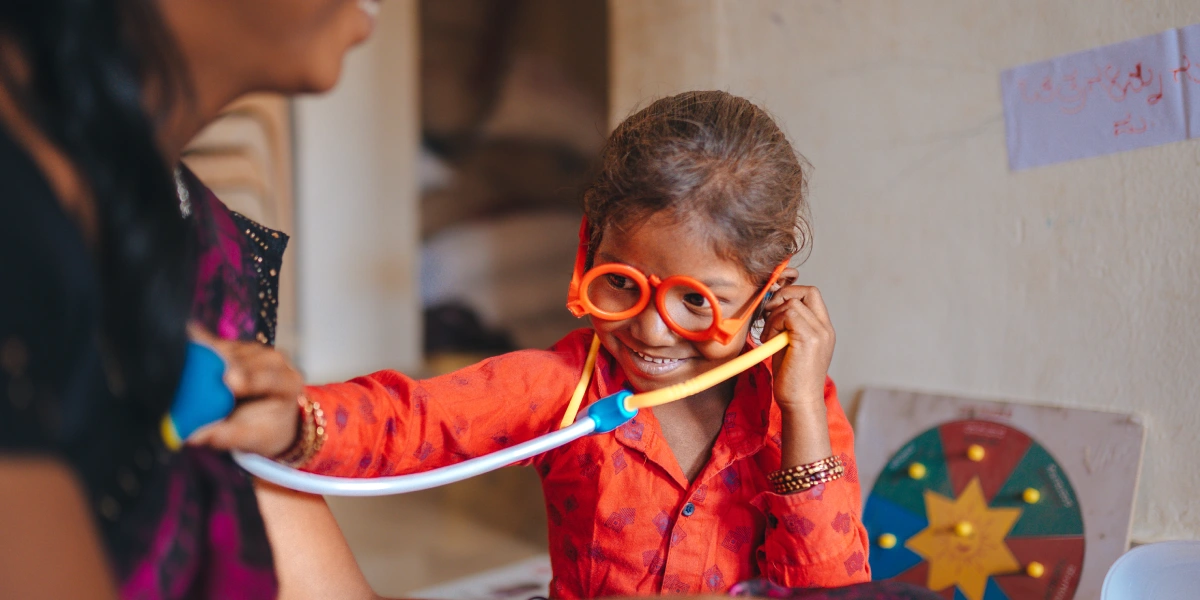
The Anganwadi, in its ideation, fits this philosophy perfectly. It is non-formal, community-based, and child-centred. The learning happens through stories, songs, routines, and interactions not worksheets or rote lessons. The teacher is seen not just as an instructor but as a facilitator, someone who could guide, observe, and nurture the child’s curiosity.
And perhaps my favourite part of it all is the mixed-age group. In an Anganwadi, you’ll often find a three-year-old and a five-year-old sharing the same mat, playing with the same blocks, or singing the same rhyme. It’s such a natural way for learning to unfold. The younger ones learn by observing and imitating; the older ones learn empathy, patience, and leadership. This dynamic mirrors real-life children growing up together, not in silos of age or ability. Every Montessori classroom in the world strives to recreate this very environment, but the Anganwadi already has it built in.
Even if we look at what the modern early years frameworks advocate, the NCF 2022, Montessori, Reggio Emilia, or HighScope, they all value play, relationships, and real-life contexts. The Anganwadi, at its core, embodies these very principles. It already holds the essence of what progressive early childhood pedagogy stands for: connection, curiosity, and learning through experience.
More than anything, the Anganwadi is built to serve the child. From ensuring the right nutrition to encouraging parental participation, it is a beautiful idea and intention. It also stands as an example of democratic education where learning is rooted in local culture, language, and values. Festivals are celebrated together, songs and stories are drawn from the community, and teaching happens in the language children understand best in their mother tongue. Many states have beautiful thematic curricula for the Anganwadis that are open enough to interpret and use as it suits the context. These are not small things; they are what make learning meaningful. And all of this is possible because the Anganwadi is non-formal and flexible, responsive to the rhythm of the community it belongs to.
Of course, it’s not without challenges, and there are many. But keeping those aside for a moment, if we continue to pursue this dream and make the Anganwadi stronger in its truest sense, I believe we will be a nation that can overcome many of our social and economic challenges. Because when we nurture the early years well, everything else follows.
But why Anganwadis and not preschools? The world today is rushing children into formal schooling earlier and earlier, mistaking early literacy for early learning. Yet, research across the globe tells us that early exposure to formal, academic instruction can do more harm than good. When children are drilled to read and write before their brains are ready, we compromise their curiosity, motivation, and even long-term learning outcomes. What young children truly need are safe, stimulating, and responsive environments, not classrooms that mimic primary schools. Anganwadis, when strengthened, can offer exactly that.
My two cents – perhaps simple, even idealistic, yet deeply necessary
- Separate administrative duties from engagement duties. There’s no way one individual can manage data, reports, and paperwork while also engaging meaningfully with children and parents.
- Create a dedicated training wing. Just like the education department, ICDS needs a strong state and district-level structure for continuous, high-quality training that is updated and rooted in quality pedagogy
- Build robust monitoring mechanisms. If we can track nutrition and immunisation, we can also monitor early learning practices and classroom quality.
- Deepen community engagement. Families and local groups should see themselves as co-owners of the Anganwadi. Accountability and participation from the community will keep the system alive and relevant.
For me, the Anganwadi represents the most powerful idea of early learning, one that is of the people and for the people. It already holds everything that modern pedagogy values: play, connection, belonging, and care.
If we reimagine and reinvest in the Anganwadi not as a welfare centre or a replica of the primary school, but as a vibrant space for early learning opportunities, we can redefine what early education looks like in India. The future of early learning doesn’t lie in importing new models or rushing to formalise preschool learning experiences; it lies in nurturing and strengthening what we already have, right here in our own communities.
Our work at Makkala Jagriti aligns closely with this vision: supporting Anganwadi educators, enriching learning environments, and deepening community engagement so every child experiences early learning the way it was meant to be.
Written by – Amrutha Murali, Deputy Director – Programs