• VOLUNTEER
  • CAREERS
  • BLOG
DONATE
  • VOLUNTEER
  • CAREERS
  • BLOG
Makkala Jagriti Makkala Jagriti
  • ABOUT US
    • VISION, MISSION, CORE VALUES
    • OUR STORY
    • OUR TEAM
    • OUR PARTNERS
    • REPORTS
  • OUR WORK
    • ECCE PROGRAM
    • HDLC PROGRAM
    • YUVA JAGRITI
    • CAREGIVERS
  • JOIN THE MOVEMENT
    • DONATE
    • PARTNER
    • VOLUNTEER
    • WORK WITH US
  • CONTACT US
  • STORIES OF CHANGE
DONATE
Makkala Jagriti

Anganwadis – India’s most powerful space for early stimulation

Home / Blogs / Anganwadis – India’s most powerful space for early stimulation

The Integrated Child Development Services (ICDS) scheme, launched on 2nd October 1975, was one of India’s most visionary steps towards improving the health, nutrition, and education of young children and women. As it completes its fiftieth year this year, it still continues to touch millions of lives across the country. 

The ICDS has stood as a pillar of support for India’s youngest citizens, catering to seven critical needs: Supplementary nutrition, Immunization, Health check-ups, Referral services, Pre-school non-formal education and Nutrition and health education. 

Each of these requires coordination and convergence across departments and stakeholders, a feat that’s anything but simple. At the centre of this massive web of services stands the Anganwadi, the focal point of all delivery and the true face of ICDS in every community.

But what has always fascinated me is not just the scale of ICDS, but the Anganwadi itself. 

Across India, today, there are about 1.4 million Anganwadis. 

If I were to look at the Anganwadi just from the preschool lens, it feels to me like the ideal space — the coming together of thoughtful pedagogy and deep cultural relevance.

Every time I visit an Anganwadi, I see how it is deeply rooted in the community. Everyone knows it: children, parents, grandparents. It’s a space that belongs to everyone. And I think that’s its greatest strength. The literal translation of the word is powerful enough – “Angan” meaning courtyard or the open space in front of a house, which traditionally served as a community gathering area in Indian homes and villages and “Wadi”  meaning a place belonging to or a small area.

So, Anganwadi literally means courtyard shelter or a place in the courtyard.

A child with a parent in an anganwadi
From a pedagogical standpoint, what the Anganwadi was designed to do aligns beautifully with what early childhood research tells us. Learning in the early years is not about formal teaching; it is about building curiosity, exploration, language, and relationships through play and everyday experiences. Theories by educators like Piaget, Froebel, and Montessori emphasize that children construct knowledge actively when they are engaged, not instructed. They learn best when the environment feels familiar, responsive, and free of fear.

The Anganwadi, in its ideation, fits this philosophy perfectly. It is non-formal, community-based, and child-centred. The learning happens through stories, songs, routines, and interactions not worksheets or rote lessons. The teacher is seen not just as an instructor but as a facilitator, someone who could guide, observe, and nurture the child’s curiosity. 

And perhaps my favourite part of it all is the mixed-age group. In an Anganwadi, you’ll often find a three-year-old and a five-year-old sharing the same mat, playing with the same blocks, or singing the same rhyme. It’s such a natural way for learning to unfold. The younger ones learn by observing and imitating; the older ones learn empathy, patience, and leadership. This dynamic mirrors real-life children growing up together, not in silos of age or ability. Every Montessori classroom in the world strives to recreate this very environment, but the Anganwadi already has it built in.

Even if we look at what the modern early years frameworks advocate, the NCF 2022, Montessori, Reggio Emilia, or HighScope, they all value play, relationships, and real-life contexts. The Anganwadi, at its core, embodies these very principles. It already holds the essence of what progressive early childhood pedagogy stands for: connection, curiosity, and learning through experience.

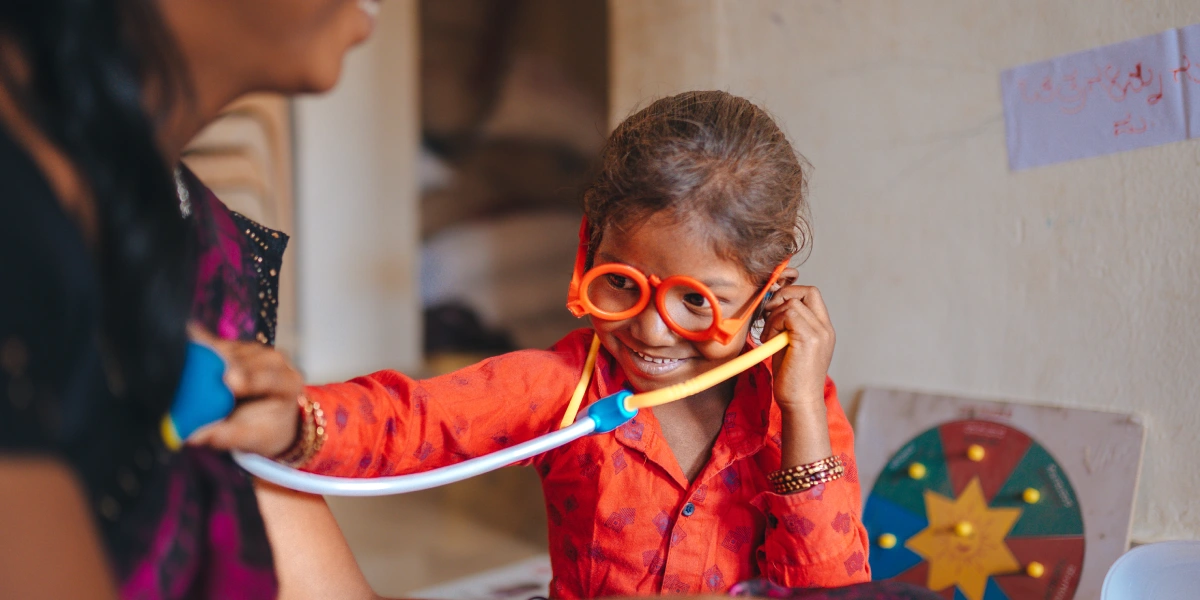
An anganwadi teacher interacting with a child through play
More than anything, the Anganwadi is built to serve the child. From ensuring the right nutrition to encouraging parental participation, it is a beautiful idea and intention. It also stands as an example of democratic education where learning is rooted in local culture, language, and values. Festivals are celebrated together, songs and stories are drawn from the community, and teaching happens in the language children understand best in their mother tongue. Many states have beautiful thematic curricula for the Anganwadis that are open enough to interpret and use as it suits the context. These are not small things; they are what make learning meaningful. And all of this is possible because the Anganwadi is non-formal and flexible, responsive to the rhythm of the community it belongs to.

Of course, it’s not without challenges, and there are many. But keeping those aside for a moment, if we continue to pursue this dream and make the Anganwadi stronger in its truest sense, I believe we will be a nation that can overcome many of our social and economic challenges. Because when we nurture the early years well, everything else follows.

Children learning through play
But why Anganwadis and not preschools? The world today is rushing children into formal schooling earlier and earlier, mistaking early literacy for early learning. Yet, research across the globe tells us that early exposure to formal, academic instruction can do more harm than good. When children are drilled to read and write before their brains are ready, we compromise their curiosity, motivation, and even long-term learning outcomes. What young children truly need are safe, stimulating, and responsive environments, not classrooms that mimic primary schools. Anganwadis, when strengthened, can offer exactly that.

My two cents – perhaps simple, even idealistic, yet deeply necessary

  • Separate administrative duties from engagement duties. There’s no way one individual can manage data, reports, and paperwork while also engaging meaningfully with children and parents.
  • Create a dedicated training wing. Just like the education department, ICDS needs a strong state and district-level structure for continuous, high-quality training that is updated and rooted in quality pedagogy
  • Build robust monitoring mechanisms. If we can track nutrition and immunisation, we can also monitor early learning practices and classroom quality.
  • Deepen community engagement. Families and local groups should see themselves as co-owners of the Anganwadi. Accountability and participation from the community will keep the system alive and relevant.

For me, the Anganwadi represents the most powerful idea of early learning, one that is of the people and for the people. It already holds everything that modern pedagogy values: play, connection, belonging, and care.

If we reimagine and reinvest in the Anganwadi not as a welfare centre or a replica of the primary school, but as a vibrant space for early learning opportunities, we can redefine what early education looks like in India. The future of early learning doesn’t lie in importing new models or rushing to formalise preschool learning experiences; it lies in nurturing and strengthening what we already have, right here in our own communities.

Our work at Makkala Jagriti aligns closely with this vision: supporting Anganwadi educators, enriching learning environments, and deepening community engagement so every child experiences early learning the way it was meant to be.

Written by – Amrutha Murali, Deputy Director – Programs
71
Like this post
Makkala Jagrithi logo

Sign up for our newsletter by entering your email id

HOME

OUR WORK

JOIN THE MOVEMENT

PRIVACY POLICY

ABOUT US

CONTACT US

STORIES OF CHANGE

DONATE

BLOG

NEWS & EVENTS

CAREERS

© Copyright 2020 Makkala Jagriti

Developed by SriKa Marketing for Nonprofits

Copy
Cleantalk Pixel
best ngo in bangalore

Empowered Teachers Create Better Learners

To ensure children get quality pre-school learning opportunities in the Anganwadi, we empower the teachers and helpers through enhancing their knowledge, skills and attitude towards early learning and development.

“Through Anganwadi trainings, I have changed in a positive way and gained confidence about myself – especially in terms of catering to all domains of early learning. I have even started making learning materials by myself to teach children”.

– Nirmala, Anganwadi teacher, Rojipura

We train teachers and helpers on experiential learning methods that can be practiced at their centres. We also organise Mothers’ Meetings and regular mentoring visits to provide on-the-job support and guidance to teachers. Anganwadi helpers are empowered to become co-teachers and have an important role in the children’s learning process, thereby not confining them to just cooking and cleaning.

“I was used to just cooking and cleaning in the Anganwadi and did not do much else. However, after I attended the ECCE trainings, I realized I had a lot of potential and could engage and teach the children just like a teacher. Now, when the teacher is absent, I engage children in preschool learning activities.”

– Rukmini, Helper, Jyothinagar Anganwadi

From giving little time to learning, to prioritizing pre-school learning and spending more quality time with children, Anganwadi teachers and helpers have come a long way.

best ngo in bangalore

A Library with Toys!

In an effort to ensure that every household in the Anganwadi community had access to child-friendly learning materials, we started a novel initiative called ‘Toy Library’, which allowed parents to borrow toys and learning resources for their children.

“The Toy Library has been very useful for children. Whatever we teach at Anganwadi, they can continue learning at home independently. Parents also feel more equipped to engage their children at home. No wonder, within just two months of its launch, over 100 toys were borrowed from our Anganwadi.”

– Bhavya, Anganwadi teacher

The Toy Library concept was welcomed by the community and the time spent on learning at home increased!

“My child always preplans what he’d like to take home from the Toy Library. He has also become very responsible in maintaining the toys because he knows he must return them! In the past 3 months, we have borrowed 20 times already.”

– Shwetha, Parent, Vijayanagara Anganwadi, Doddaballapur

anganwadi school

Nammoora Anganwadi

We have seen great transformation take place when parents and community members are involved in shaping learning spaces for children and understand the importance of preschool education. The Anganwadi at Katamnallur, Bengaluru, transformed from a dull space to a vibrant and colourful learning centre, where children love to visit every day and parents and community members gather to participate in various activities.

“When we started our intervention, we saw that the environment at the Anganwadi was not safe or conducive for children. Although the community could contribute to the Anganwadi’s development, there was a major gap between the community, local leaders and Anganwadi teachers.”

– Gouri, Coordinator

Through community celebrations and fun events, we involved community members in the Anganwadi activities. As their participation grew, their understanding about the significance of early learning and development also increased and they readily contributed to the centre’s development.

“Community involvement in Anganwadi is so important. Inspired by Makkala Jagriti’s work, we saw the community, parents and Bala Vikas Samithi members come together and show greater ownership towards the Anganwadi.”

– Subramanya Swamy, Doddabanahalli Gram Panchayat Member

best ngo in bangalore

Equipping parents to become positive influencers

Manoj, a 12-year-old boy, hails from a family of garment workers who had migrated from Andhra Pradesh. On moving to Bengaluru in 2018, he joined the Government Primary School in Ulsoor. The drastic change in his environment and culture left him feeling withdrawn and fearful. He refused to speak or participate in any school activity. Over time, he confided in our HDLC facilitator about feeling neglected by his parents in such difficult circumstances.

Manoj’s mother was invited to participate in Makkala Jagriti’s parents’ workshop. The two-day residential workshop allowed her to reflect on her own mindset, biases and relationship with her son. At the end of it, she made a conscious decision to work on rebuilding and restoring her relationship with Manoj. At school, our facilitator noticed that this had a direct impact on his performance. He became more participative and improved in his academics. Manoj later shared with the facilitator that his relationship had become more harmonious and positive with his mother.

best ngo in bangalore

Breaking the language barrier for migrant children

Barnalli, a seventh grade student at Government Primary School, Somasundrapalya, is a child of migrant parents from Assam. Unable to speak the local language, Kannada, she found it difficult to adjust to school and struggled to mingle with other children.

“When you are new to a place and don’t know anyone, it is hard to fit in. She didn’t have any friends in school.”

– Barnalli’s mother

Makkala Jagriti’s language development program came to her rescue.

“Although I was in a higher grade, the HDLC facilitator taught me Kannada right from the basics. The different activities and sessions helped me grasp the language easily and quickly. Over time, Kannada moved from being just a new language to my favorite subject. Learning Kannada helped me enjoy school a lot more. I became a class leader and also started representing the school in inter-school competitions!”

– Barnalli

anganwadi school near me

How the education of one girl can impact generations ahead

Both of Mercy’s parents worked in the unorganised sector, who could not afford her school fees. She joined Makkala Jagriti Learning Centre at the age of 11, and always found the facilitators to be warm, welcoming and encouraging. Makkala Jagriti also supported her to pursue her education.

“We had a lot of freedom to explore our interests and talents. They taught us life skills and values. It was a new world for me.”

– Mercy

Through the Yuva Jagriti career guidance programme, Mercy received the right kind of insight and encouragement that led her to pursue a degree in Commerce, that too through a merit seat. Being the first girl in her family to study that far, she set an example in her community and made choices that allowed her to move beyond the circumstances that she was born into. Mercy now works in a reputed bank and is among our celebrated many who not only made a difference in their own lives but continue to do so in that of others.

anganwadi centres

Turning a Misguided Youth into a Community Leader

Prabhu was a teenager when the old, dilapidated building in which his family lived collapsed, leaving them without a home. While they were still grappling with the situation, Prabhu lost his father, the sole earning member of the family. Unable to process his difficult circumstances, he found strength in hanging around with his friends, who often indulged in gang wars and all forms of abusive behaviour.

Prabhu was a shy yet playful boy when he joined the Yuva Jagriti centre at the age of 15. He expressed, “I feel I am at crossroads, not sure which road to take”. Following our support and guidance, he decided to pursue an internship at Makkala Jagriti. He was entrusted to work with children from Shelter Homes. Today, Prabhu is a sought-after Creative Facilitator and Coordinator at Makkala Jagriti, managing three Community Centres. A silent yet sound performer, he brings in diverse and highly creative ways to engage children and help them learn and grow.

best ngo in bangalore

From a 10th Std. dropout to a World Taekwondo Champion

Murali lived in Bengaluru with his brother, while his parents lived in a village in Tamil Nadu. After his 10th grade, he lost the interest and inclination to study further. When he joined Yuva Jagriti, he started learning Taekwondo at our centre, which helped him become calmer and more focused. He also showed immense capacity to work with children, especially in the areas of sports and creativity, and this landed him an opportunity to work with Makkala Jagriti. Alongside his work, he pursued Taekwondo and competed at the District, State and National levels. He won a number of Gold Medals.

Today, Murali is an accomplished Taekwondo instructor, teaching at many schools in Bengaluru. He brought great accolades to the Nation when he won two bronze medals at the World Taekwondo Championship in Korea in September 2017.